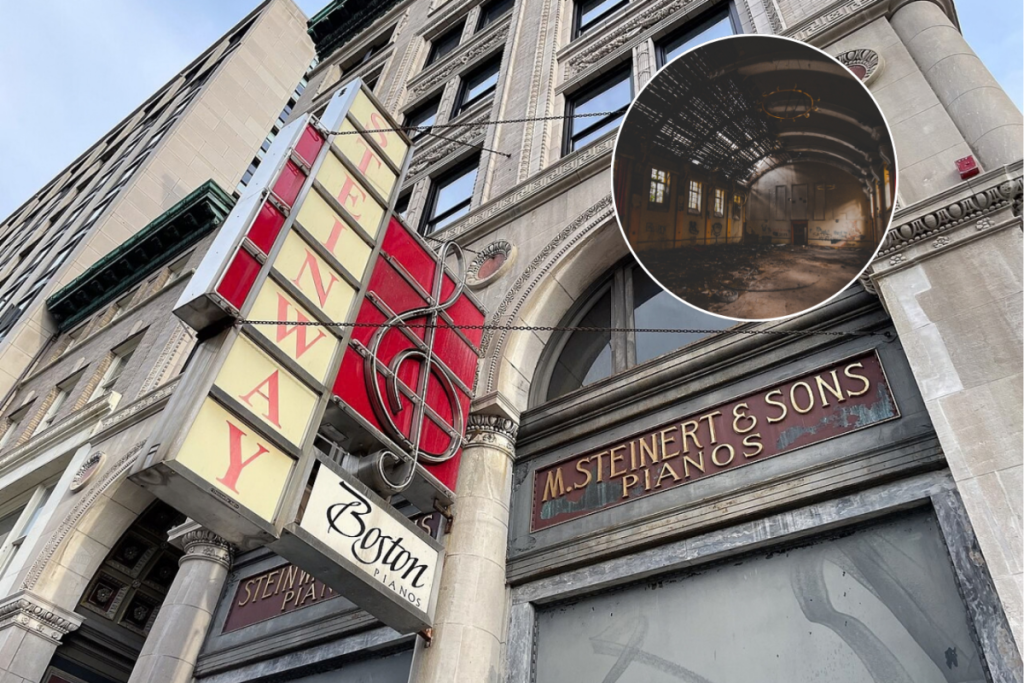

You could walk down Boylston Street, glance toward Boston Common, and have absolutely no idea that an abandoned concert hall sits several floors beneath your feet. 40 feet beneath your feet, to be exact.
Concealed four floors beneath a Boston piano store lies what was once one of the city’s crown jewels of classical music; a grand concert hall that eventually had to pull the curtains for the final time, leaving a remarkable relic of Boston’s bygone glamour hidden underground for more than 70 years.
And with Halloween around the corner, there’s something undeniably eerie about knowing that this forgotten piece of Boston’s musical history is sitting in the darkness below one of the city’s most familiar streets.
One of Boston’s best-kept secrets is hidden beneath a Boylston Street piano store
Known as Steinert Hall, the underground venue opened in 1896 and quickly earned a reputation for its exceptional acoustics and ornate interiors. The hall was part of the Steinert & Sons piano business at 162 Boylston Street, which had established itself as an important part of Boston’s music scene.
When demonstrating their pianos, Steinert & Sons had to contend with the noise of Boylston Street, from passing streetcars to the steady foot traffic outside. The solution was to take the music underground.
Steinert Hall was built as a space where the company could showcase its pianos in concert, allowing audiences to hear them at their best without the distractions of the street above. It didn’t take long for the hall to develop a reputation of its own. Its exceptional acoustics earned it the nickname “Little Jewel”, while the ornate underground space could accommodate around 700 people.
High arched walls, domed ceilings and panels bearing the names of composers including Mozart, Beethoven and Bach gave the hall an appropriately grand setting. By the early 20th century, it had established itself as an important hub for music and the arts in Boston.
Why did Steinert Hall close?
Despite the concert hall attracting flocks of concert goers, and big names including Sergei Rachmaninoff, Ignacy Jan Paderewski, Fritz Kreisler, Harold Bauer and Josef Hofmann, the final curtain was called in 1942.
On November 28 of that year, the Cocoanut Grove nightclub fire killed 492 people in Boston, making it the second deadliest nightclub fire in U.S. history. The tragedy prompted major changes to fire-safety regulations and evacuation requirements in Boston and beyond.
The tragedy exposed serious problems with the way public venues were designed for emergencies, from inadequate exits and overcrowding to difficulties getting people out quickly when panic set in.
In the aftermath, Boston and Massachusetts introduced sweeping changes to fire-safety and building regulations. The state’s Board of Fire Prevention Regulations was itself established as a result of the disaster.
Revolving doors in particular came under tighter restrictions, with conventional swinging doors required alongside them in many situations. They became subject to strict limitations and, if you have ever wondered why they are always accompanied by conventional swinging doors, this tragedy is why.
Due to its location below street level, the challenges surrounding safe evacuation, and one singular entrance and exit, the Steinert Hall could not meet the new requirements without major alterations. It closed in late 1942 and never returned to its former role as a public concert venue.
What is Steinert Hall used for today, and is it haunted?
Steinert Hall may no longer host regular concerts, but it hasn’t been completely forgotten. The underground space has occasionally been used for recordings, rehearsals and other private purposes, with musicians and a handful of visitors gaining access over the years.
Pianist Janice Weber, for example, recorded albums inside the hall, taking advantage of the same unusual acoustics that made it famous in its heyday. Even Elton John reportedly visited the hall while passing through Boston.
For everyone else, though, the hall remains largely out of bounds. That, combined with its decades of disuse and deteriorating interior, has inevitably given Steinert Hall a reputation as one of Boston’s eerier hidden spaces.
So, is it haunted? There are plenty of ghostly rumors surrounding a forgotten underground concert hall, but despite the President of M. Steinert & Sons, Paul Murphy, joking “The ghosts come around every once and awhile,”, there’s no well-documented evidence of paranormal activity at Steinert Hall.
Can you visit Steinert Hall?
Unfortunately, Steinert Hall isn’t open to the public, with its deterioration and modern safety requirements making access extremely limited. So you can’t simply wander downstairs and explore the forgotten concert hall for yourself.
You can, however, still enjoy live classical music in some of Boston’s most atmospheric historic spaces. Candlelight concerts bring string quartets and other musicians to venues around the city, with programs ranging from classical favorites to modern tributes.
It’s not quite the same as descending 40 feet beneath Boylston Street, but it’s a pretty good alternative if the idea of hearing live music in a beautiful historic setting appeals to you.
11 December 2026 19:00 + more dates
Simons Theatre
13 November 2026 19:00 + more dates
Simons Theatre
24 October 2026 19:00 + more dates
Simons Theatre
24 October 2026 21:00 + more dates
Simons Theatre
7 November 2026 19:00 + more dates
Simons Theatre
7 November 2026 21:00 + more dates
Simons Theatre
5 November 2026 20:30 + more dates
First Church in Cambridge
5 November 2026 18:00 + more dates
First Church in Cambridge
So, if you happen to be walking along Boylston Street near Boston Common, keep an eye out for the Steinert Hall sign. You won’t be able to head inside, but knowing that a former concert hall is tucked away beneath the piano store makes for a pretty great piece of Boston trivia to point out to your friends as you walk by.