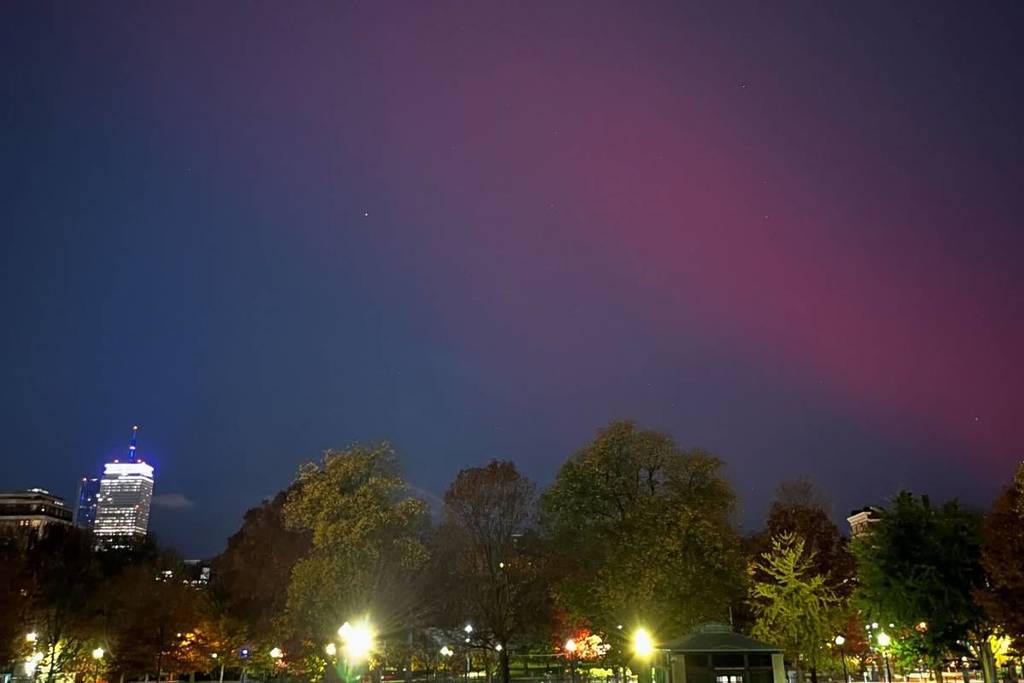
The Northern Lights, also known as Aurora Borealis, put on a rare and stunning display across New England on the night of November 11, 2025, lighting up skies from Massachusetts to Maine with vibrant hues of pink, green, and purple. Skywatchers reported breathtaking views in dozens of towns, with photographs capturing the phenomenon above both rural woodlands and urban neighborhoods, even illuminating Boston Public Garden.
What caused the aurora?
Meteorologists attributed this unusual event in New England to a powerful geomagnetic storm triggered by a coronal mass ejection (CME) from the sun. The CME sent a surge of charged solar particles toward Earth, resulting in a rapid and dramatic spike in the planetary Kp index—an indicator of geomagnetic disturbance—which reached as high as 8.67, making the aurora briefly visible as far south as the Carolinas and even Georgia.
When is the next chance to see Northern Lights in Boston?
Scientifically, the Northern Lights occur when those high-energy particles from the sun collide with gases in the Earth’s upper atmosphere. Oxygen emits green and sometimes red light, while nitrogen produces purple, blue, or pink glows. The current display coincides with the sun’s active phase in its 11-year cycle, which increases the frequency of such solar storms and the likelihood of auroral activity far from the poles.
Forecasters note that while the spectacle is unpredictable and often fleeting, solar activity remains high, suggesting further chances for New Englanders to witness this celestial wonder in the coming days, November 11-13, and again in the coming months. According to NOAA, “watches have been posted as: G2-Moderate for 11 Nov; G3-Strong for 12 Nov; and G1-Minor for 13 Nov.”
The aurora is best viewed from 9 PM-2 AM, assuming clear skies.